
Case study: Control-panel jacketed tank for cosmetics production
Challenge
A single high-spec tank was being used to manufacture a wide range of OEM and private-brand products — an inefficient setup, since even simple products ended up relying on high-end equipment they didn’t actually need.
Solution
Discovering MONOVATE’s control-panel jacketed tank technology at a trade show, and building a large-capacity 600L mixing tank to establish a more efficient production setup.
Expected Results
A flexible production structure tailored to each product’s characteristics, with more efficient parallel production raising overall manufacturing capacity.
Customer profile: Hadabiwa Co., Ltd., a specialist manufacturer of horse oil and horse placenta products, based in Kumamoto with an integrated production system from raw material to finished product. The company handles a wide range of OEM and private-brand manufacturing, producing high-quality cosmetics and skincare products efficiently, and brings traditional Kumamoto horse-oil craftsmanship together with modern quality control.
A Trade Show Encounter That Reshaped Production Efficiency
The company first came across MONOVATE at a trade show, where a load-cell unit tank with a control panel was on display — exactly the kind of control-panel-equipped tank they’d been looking for, which led directly to their inquiry.
Seeing that unit convinced them MONOVATE had genuine manufacturing expertise in control-panel jacketed tanks. What sealed the decision was MONOVATE’s ability to customize the equipment to their specific requirements, along with its technical capability in building automated control-panel systems.
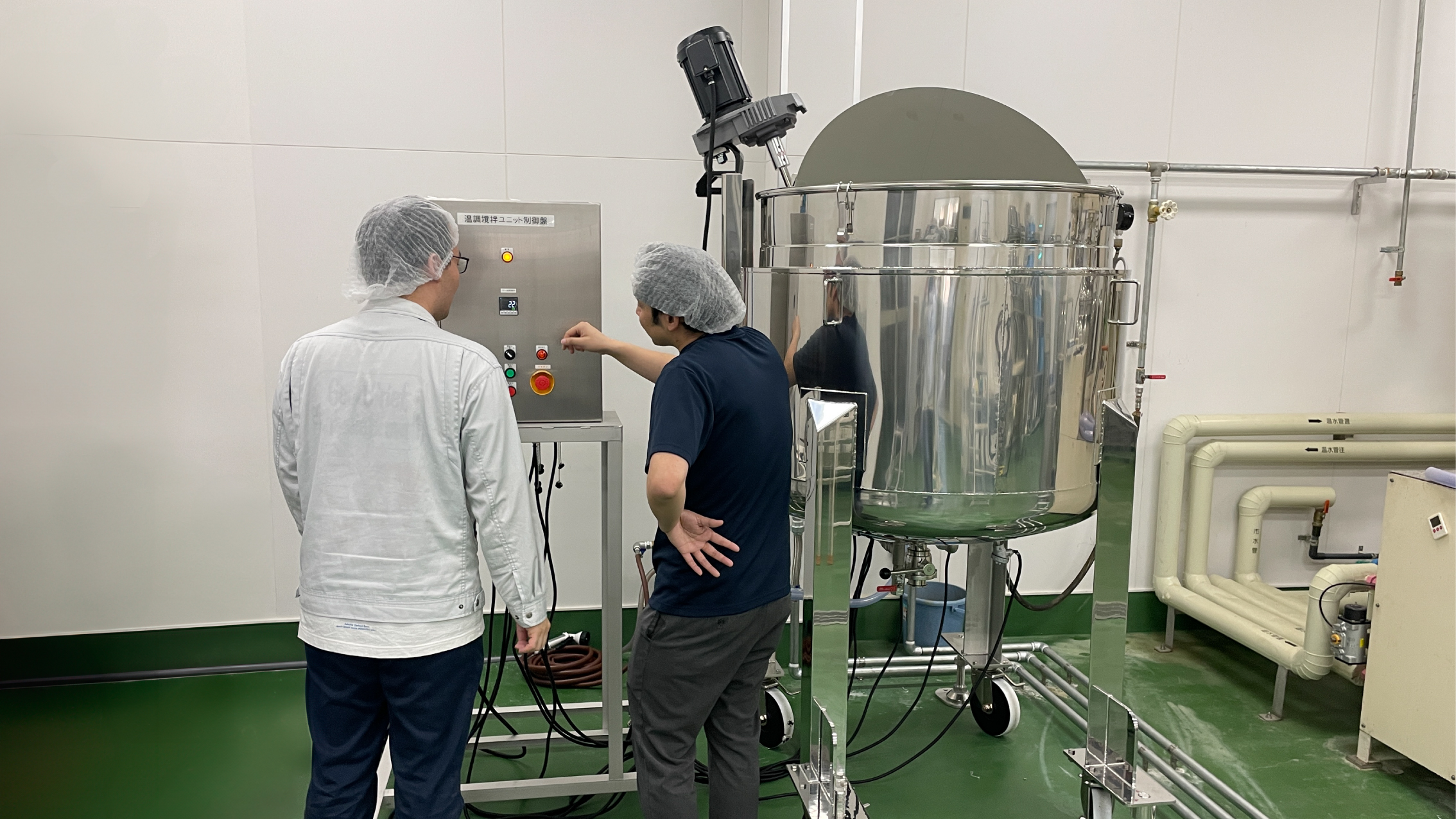
Moving From One High-Spec Tank to a Multi-Line Setup
Previously, the company had been manufacturing many of its products using a single high-spec tank capable of vacuum mixing. As production volume grew, it became clear that products not requiring vacuum mixing would be manufactured more efficiently in a larger-capacity tank — which is what led to installing this new equipment.
The new system automates temperature control by running steam or cooling water through the jacket, switching between them using solenoid valves managed by the control panel — steam to warm the contents, cooling water to cool them, with automated management throughout.
Since the company handles a large volume of OEM and private-brand manufacturing across many different formulas, relying on a single high-spec tank for essentially all of it had become inefficient. Many of those products don’t actually require that tank’s full capability, which is exactly why they wanted a second line running in parallel.
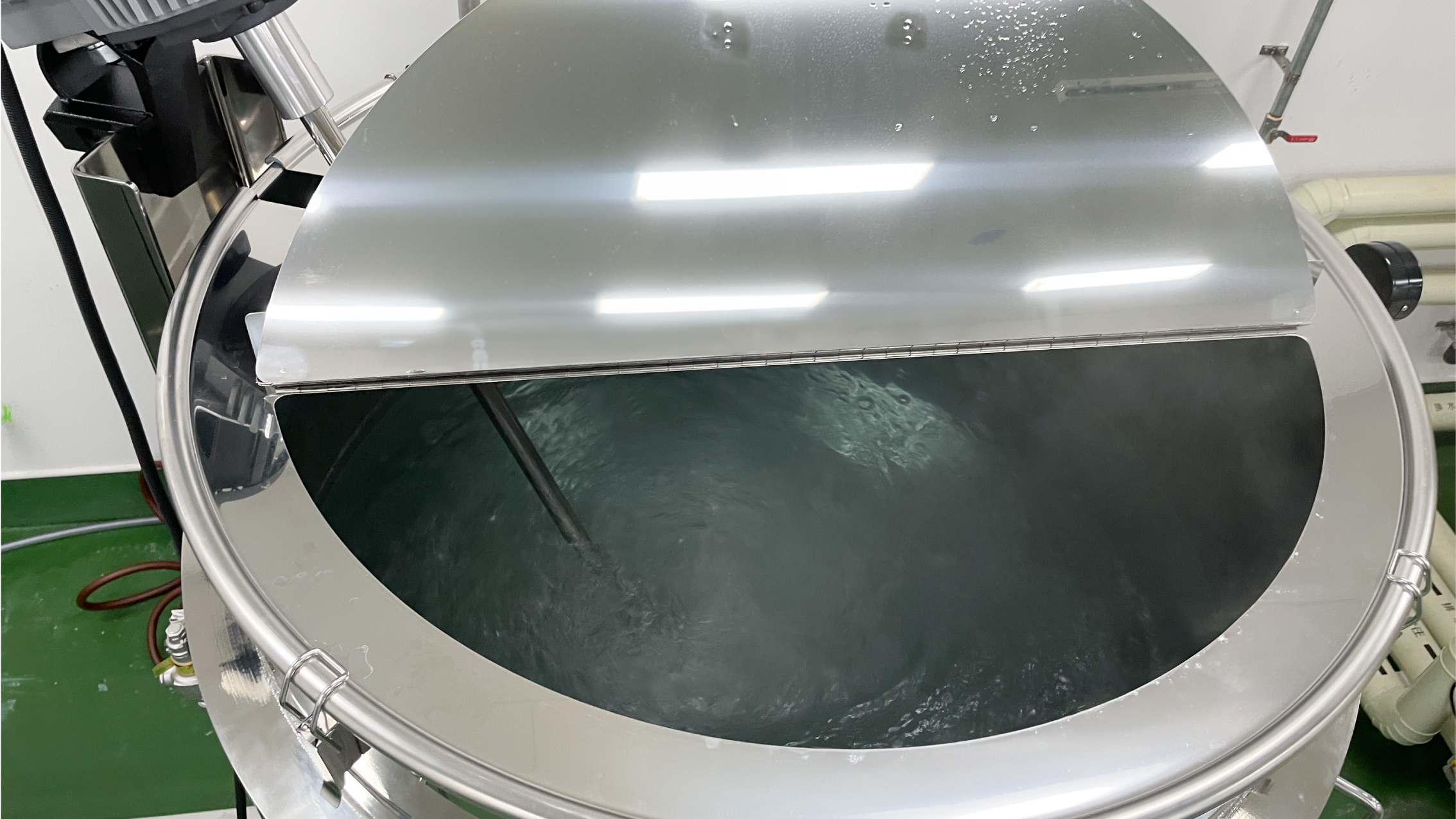
What They’re Expecting From the Control-Panel Jacketed Tank
The new tank offers both large-capacity production and the efficiency gains that come with control-panel automation. As this is still an early-stage rollout, they expect further customization and updates may be needed down the line — something they’re already planning to bring back to MONOVATE.
Overall, they expect a production line tailored to each product’s characteristics to meaningfully raise their total manufacturing capacity.
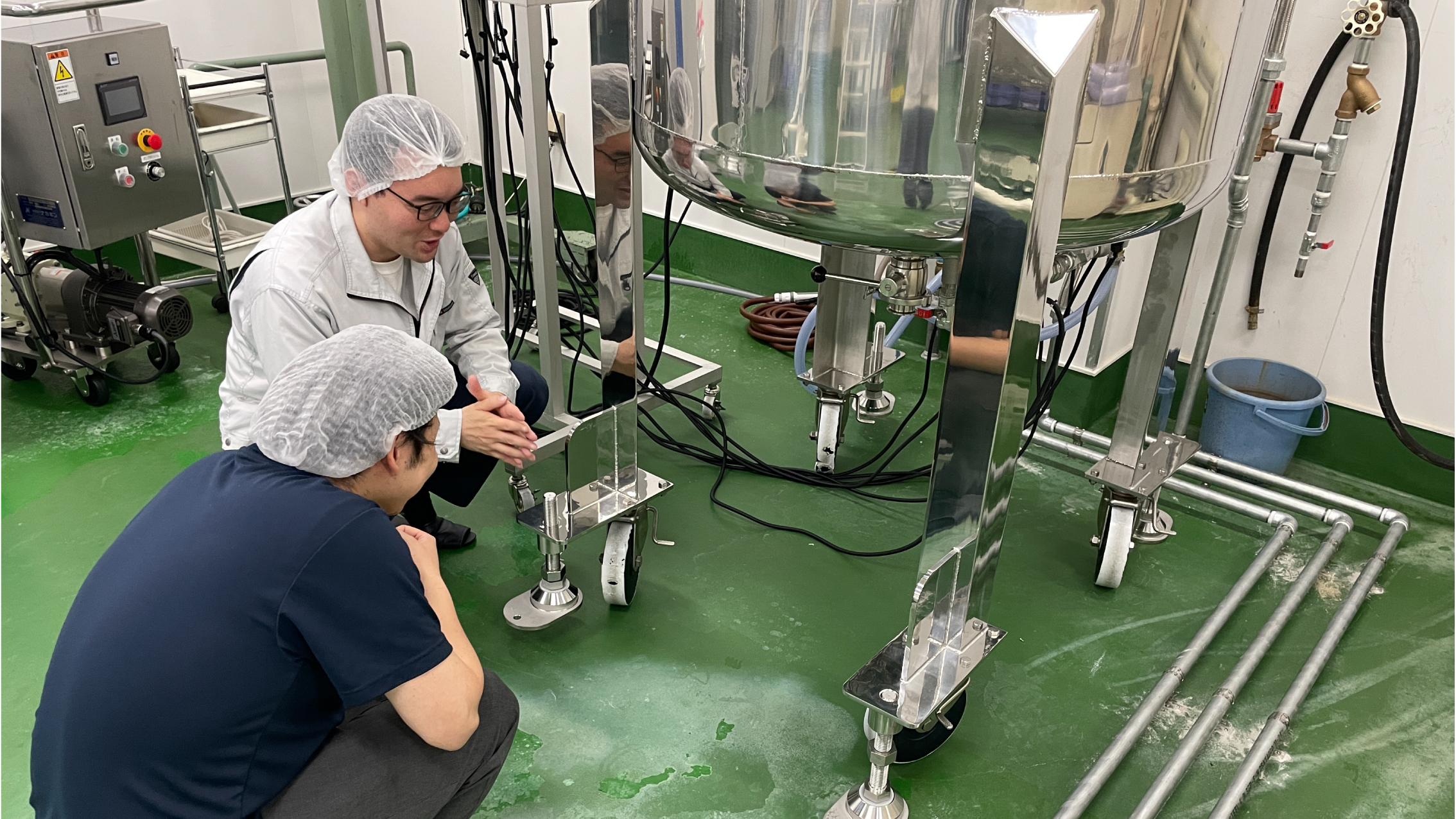
What’s Next
They anticipate further refinements — this larger-capacity tank, for instance, will likely need additional storage tanks to match it — and further updates are likely as they go. Since their planning so far focused mainly on getting the equipment installed, they’re looking forward to continuing to bring requests to MONOVATE, aiming for an ongoing partnership that keeps driving efficiency further.
From the sales team: This project began with an inquiry after the customer saw our control-panel-equipped tank at a trade show, and we’re glad we could help resolve a real bottleneck in Hadabiwa’s multi-product manufacturing through the right equipment specification. We were involved end-to-end — manufacturing, transport, handover, and installation — and got to see exactly where in the plant our equipment would be placed and used. Beyond consultations about accessory parts after installation, we plan to keep supporting them on any other issue a stainless steel solution might address. We’ll keep working to meet the improvement needs we find on our customers’ floors with our technology.
Editor’s note: For this interview, we spoke with the team during the tank’s installation itself, about the background behind the project and the results they’re hoping for. Hearing genuine, on-the-ground perspective, and picturing together how the equipment will actually help, made for a valuable conversation. Hadabiwa’s team stayed warm and attentive throughout, despite being in the middle of a busy installation — we’re truly grateful, and it made for a valuable time for us as well. We hope to keep being a useful manufacturing partner going forward.
No tags for this post.