
Case study: Pharmaceutical manufacturer custom mixing tank
Challenge
- Heavy manual transport: 20-liter batches of liquid had to be carried by hand from a separate mixing room to the production room.
- Mixing that depended on one person’s feel: with an air-driven mixer, speed was hard to control, and operators had to watch for sinking, foaming, and separation, adjusting by experience alone.
Solution
- A custom 150-liter mixing tank: purpose-built around the exact behavior of this liquid.
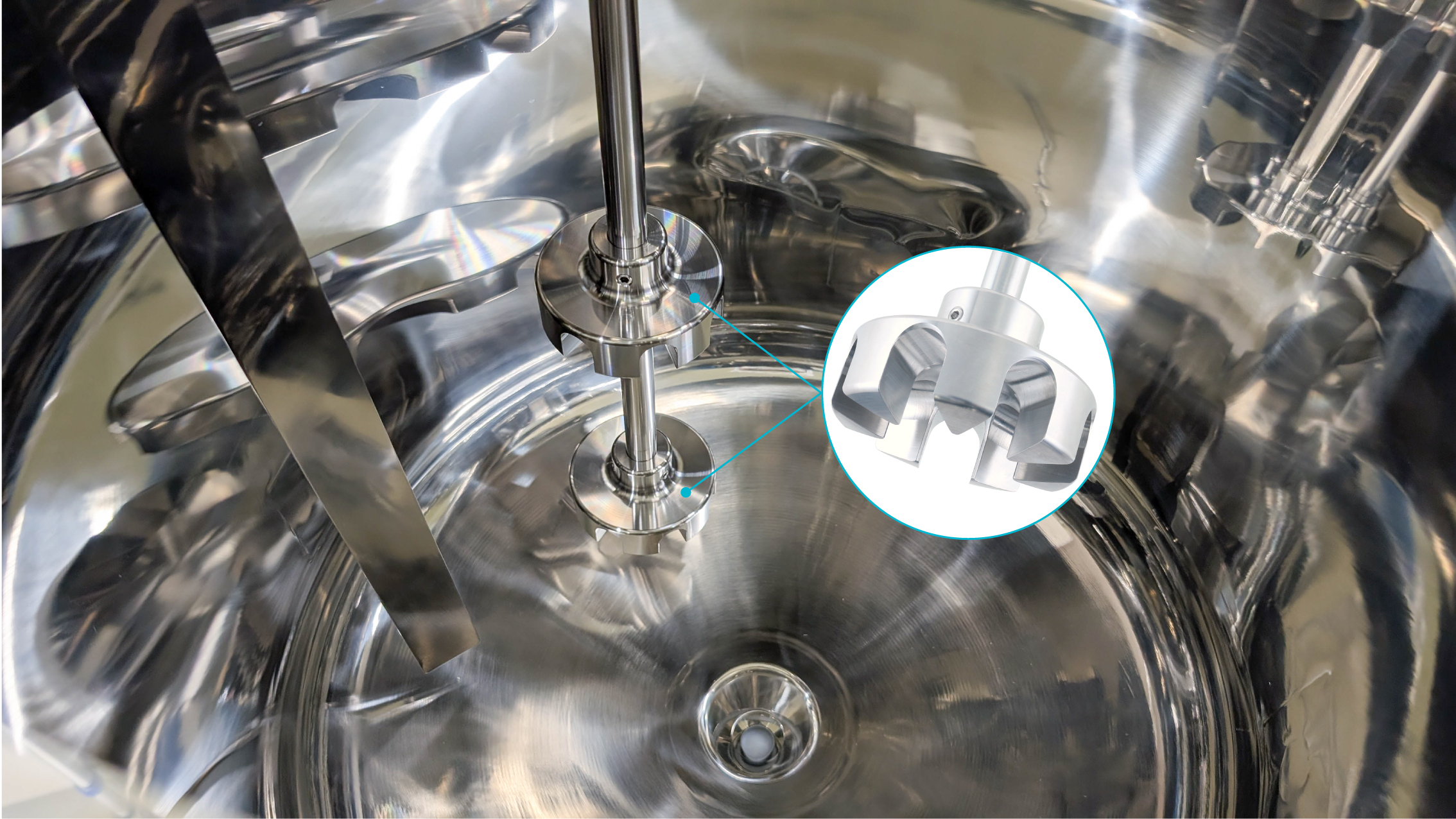
- A two-tier Bernoulli-flow mixer: strong enough to keep mixing all the way to the bottom of the tank, without whipping in excess air.
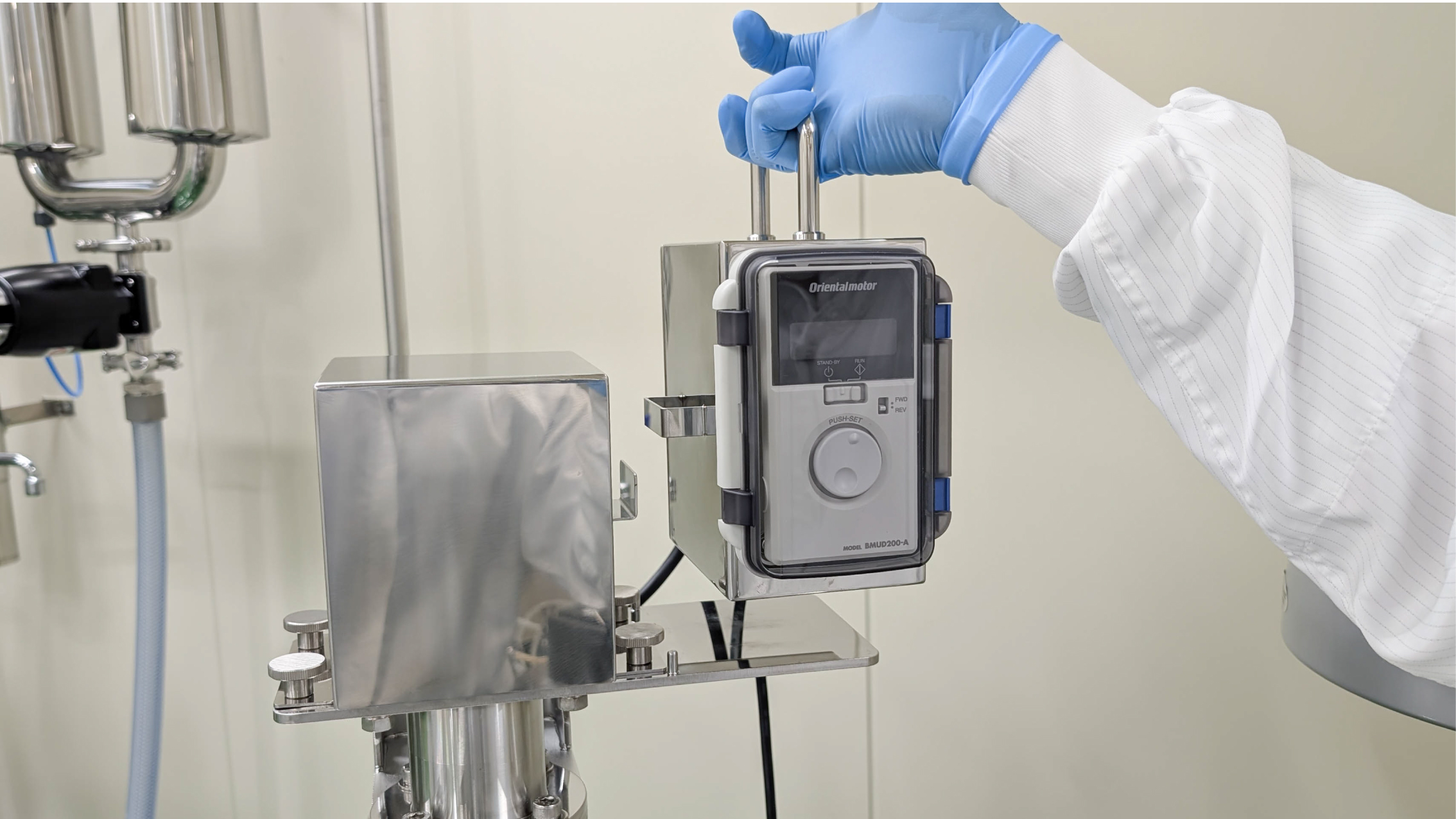
- A detachable controller and a custom motor cover: a controller that unclips for cleaning, and a cover that shields the motor from powder and liquid.
Expected Results
- Consistent quality even with a difficult liquid: the Bernoulli-flow mixer suppresses settling, foaming, and emulsion breakdown, keeping the mixture uniform at all times.
- Up to 7–8x more output with a tenth of the manual labor: scaling from 20L to 150L means far larger batches in a single run.
- Less room for human error: mechanizing the process removes the dependence on individual skill.
Customer profile: Nippon Chemiphar Pharma Co., Ltd., founded in 1960, a group company of drug developer Nippon Chemiphar. The company manufactures and sells prescription medicines centered on generics, with a focus on solid oral dosage forms that support quality-driven healthcare in Japan.
The Process — and the Problem Before the Upgrade
This tank produces granule coating liquid: a liquid used to coat roughly 100-micron granules before they’re formed into tablets. Once made, the liquid is fed slowly — over more than six hours — into a fluidized bed granulator-dryer, which handles granulation and drying at the same time.
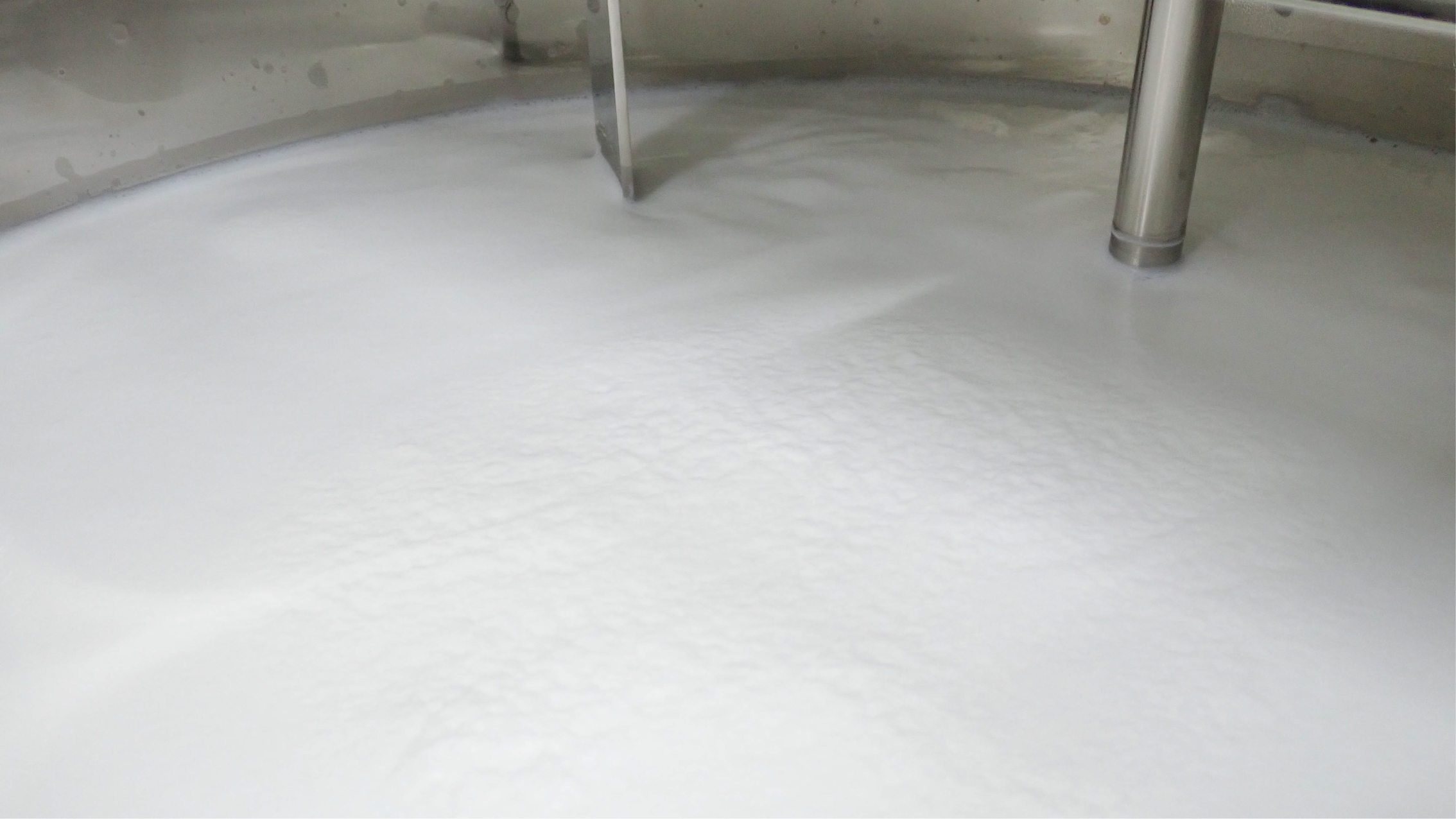
Previously, production ran at around 20 liters, with the mixing room physically separate from the production room — meaning the liquid had to be transferred into containers and carried over by hand. That alone was a significant physical burden on staff.
The second issue was that mixer operation depended entirely on individual skill. With an air-driven mixer, rotation speed was difficult to fine-tune, so operators had to judge the mix visually and adjust based on experience. Too little agitation and the ingredients would settle; too much, and foaming would start, or the emulsion would break and separate. Someone had to watch continuously for proper mixing and foam — and every adjustment relied on judgment built from experience.
The move to a 150-liter tank came with a plant relocation to a new building, which was the original opportunity to scale up. But this particular liquid has very sensitive mixing requirements, so MONOVATE built a fully customized tank around it — including a two-tier Bernoulli-flow mixer arrangement tailored to the liquid’s behavior.
The Custom Specification Behind a Difficult Liquid
The liquid needs constant agitation throughout production. It looks thin and watery, but it contains components that settle out if left still for as little as 15 minutes. At the same time, it contains an emulsifier, so mixing it too aggressively breaks the emulsion and causes separation — similar to what happens when you heat mayonnaise and it splits. Foaming has to be avoided too. In short: agitation is essential, but it can’t be too strong.
The Bernoulli-flow mixer solved exactly that problem — it draws in very little air while still delivering strong mixing power. A demo unit was tested with the actual liquid, and the results were excellent. The impeller was configured in two tiers, so mixing continues effectively even after more than six hours, once the liquid level drops close to the bottom of the tank.
Two other details were customized further. The original proposal used a non-waterproof controller fixed with a knurled knob, which had to be removed every time the tank was cleaned — a recurring hassle for operators. MONOVATE redesigned it as a hook-mounted controller that detaches easily and can be set aside during cleaning, so operators no longer have to worry about splash water near it.
A cover was also added around the motor. Because the room handles both powder and liquid, any buildup on the motor’s uneven surfaces would make cleaning difficult. Reaching the final specification took repeated rounds of discussion — the customer describes it less as “leaving it to the manufacturer” and more as something built together.
Why This Pharmaceutical Manufacturer Chose MONOVATE
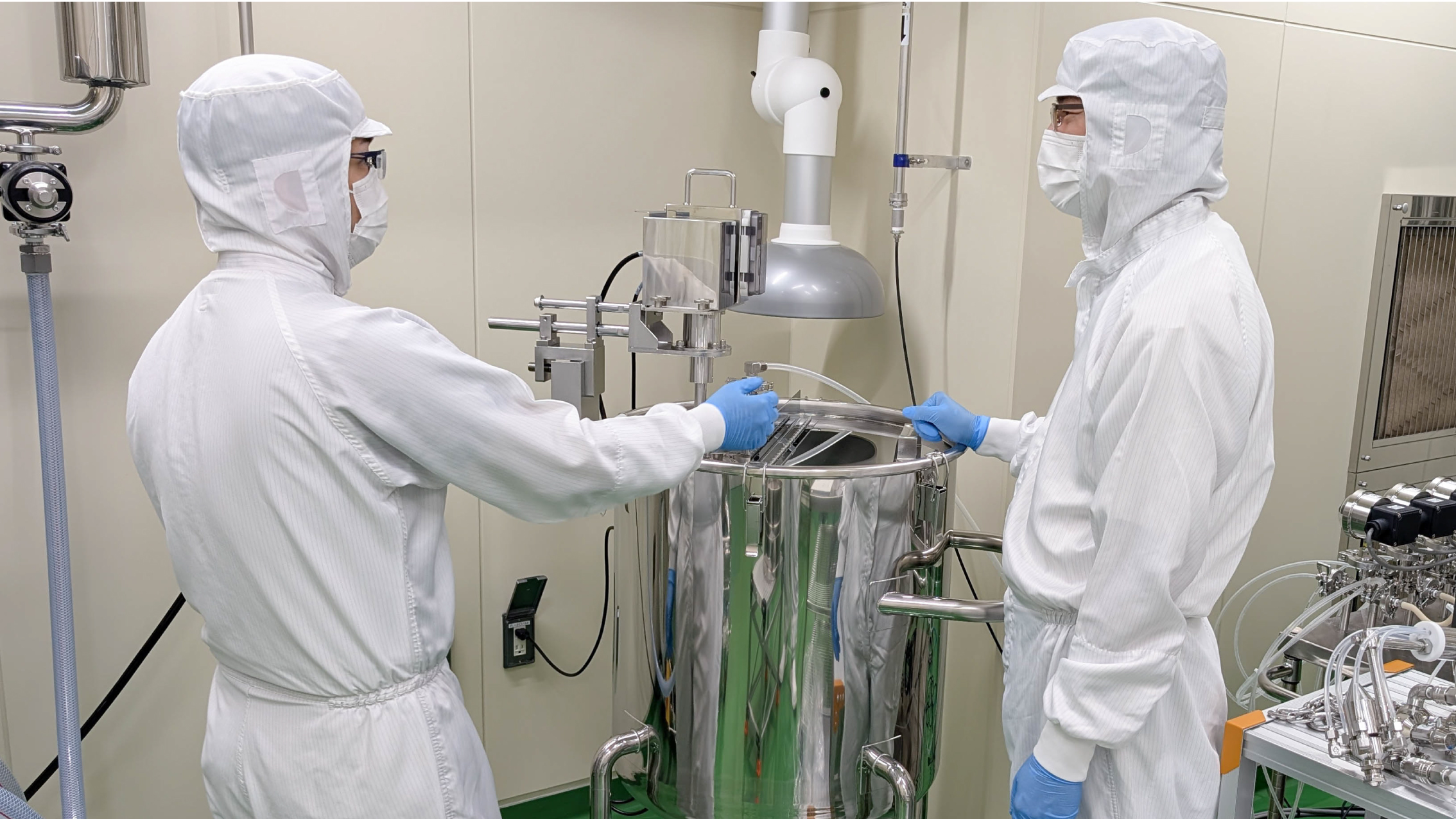
Among the many manufacturers they considered, the deciding factor was the speed of response from MONOVATE’s sales representative. Where other companies’ sales reps would say “let me check” and then go quiet for a while, MONOVATE turned design feedback around genuinely fast — and came back with additional proposals on top of what was asked, offering perspective as a professional partner rather than just an order-taker. Response speed aside, the cost advantage was significant as well.
Pharmaceutical manufacturers also have to vet suppliers formally before selecting equipment for their plants, evaluating business scale, structure, and support. It’s often compared to buying a car: you wouldn’t buy from a manufacturer with weak quality assurance or support, and manufacturing equipment is no different. MONOVATE already had a track record with this customer on a previous tank installation, backed by solid support — which made it easy to trust them with this project too.
MONOVATE also provided IQ (Installation Qualification) document templates in advance, which made the process go far more smoothly. Whether or not a supplier can provide that kind of documentation up front, they note, makes a real difference.
The Results They’re Expecting
Manual labor is expected to drop to roughly a tenth of what it was. Running 150 liters without this tank would mean staff repeatedly tracking the clock and feeding the liquid in through 30-liter containers, three to four times over.
With the Bernoulli-flow mixer now suppressing both settling and foaming continuously, the liquid can instead be fed steadily through a hose over more than six hours straight from the tank — eliminating the batch-carrying work entirely. Scale increases 7–8x, and overall efficiency goes up with it.
Human error risk drops too. Operators no longer need to continuously monitor mixing consistency and foam by eye; setting the rotation speed on the machine gives everyone the same result, removing the dependence on any one person’s experience.
When the change was explained to the operators who’d be using it, the reaction was straightforwardly positive: relief that the workload was about to get lighter.
What’s Next
The customer feels MONOVATE was able to turn their intent into a real, working design. They’re now looking into a 350-liter tank as a next step, and plan to keep working with MONOVATE on future proposals and advice.
What stood out most, in their words, was MONOVATE’s ability to deliver genuine customization while still meeting pharmaceutical industry regulatory requirements.
Editor’s note: The more we heard about this liquid — thin enough to look easy to handle, yet prone to settling, and just as prone to breaking apart if mixed too hard — the clearer it became how difficult it really was to work with. What stood out throughout the interview was how often the customer described the process as something built together, rather than simply handed off to a manufacturer. We’re glad our sales and design teams could walk alongside a customer who had such a clear sense of what they wanted and helped turn it into reality, step by step. We hope this case offers a useful reference for anyone in pharma or food manufacturing wrestling with a liquid that settles, foams, or separates too easily. Thank you for the generous, detailed tour of your facility.
No tags for this post.